Is it legal to download Pinterest videos? The short answer
Saving a video for yourself is the low-risk end; reposting it as your own is the high-risk end.
Copyright stays with whoever made the clip, Pinterest's terms say so, and the copyright offices we read say that permission or a legal exception is what allows someone else's use. Everything in between depends on the facts.
This is not legal advice. We are a tool, not a law firm. For a decision that matters, such as using a clip in a paid project, ask a lawyer where you live.
There are two separate questions, and people often mix them up. The first is copyright: does your use of the video need the creator's permission? The second is Pinterest's own rules: what does the service allow its users to do? The sections below answer each one from the source documents, with links.
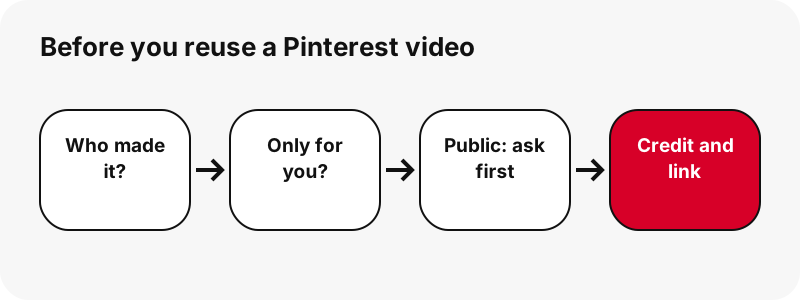
Who owns a video you find on Pinterest?
The person who made it, or whoever they gave the rights to; not Pinterest and not you. Pinterest's Terms of Service say that people who post retain all rights in what they post. Pinterest's help on copyright adds that a copyright is generally owned by whoever creates the work.
“Where necessary, permission to use a given image or video that you find on Pinterest should be sought from its copyright holder.”
Two details make this harder in practice. Many pins are saved by someone other than the creator, so the profile on the pin may not be the owner. And Pinterest states it has no information about who owns the copyright of a given pin, so it cannot put you in touch with them either.
Ownership also does not need a registration or a © sign. The U.S. Copyright Office says a work is protected the moment it is created and fixed in a tangible form, and the Berne Convention, summarised by WIPO, says protection must not be conditional upon compliance with any formality.
What do Pinterest's own rules say about downloading?
They give a mixed picture, and we would rather show you all of it than only the convenient part. Pinterest offers a Download image option for some pins, and its help says downloading a Pin saves the image to your device. That help article covers images and warns that not all pins can be downloaded.
The Terms of Service also say that by posting, users grant Pinterest and "our users" a license that includes the right to save and download their content. Here is the exact wording:
“you grant us and our affiliates and service providers, and our users, a non-exclusive, royalty-free, transferable, sublicensable, worldwide license to use, store, publicly perform or display, reproduce, save, modify, create derivative works, monetize, download, translate and distribute your User Content”
On the other side, the Community Guidelines ask people not to use any undocumented or unsupported method to access, search, scrape, download or change any part of Pinterest, and the Terms ban scraping or copying content in unauthorized ways, such as automated means.
SaverPin is independent; it is not a method Pinterest documents. That is a matter between a user and Pinterest's terms, separate from copyright.
We read these documents on 2026-10-24. Pinterest has announced updated Terms and Community Guidelines effective November 12, 2026, so check the current versions.
Saving, downloading and reposting: what is the difference?
They are three different acts with three different effects. Pinterest's help draws the first line itself: saving adds a pin to one of your boards, downloading puts a copy of the file on your device. Reposting is a third step, and it is the one copyright cares about most.
| Act | What happens | Who owns the video afterwards | What the sources say |
|---|---|---|---|
| Save to a board | The pin is added to your board on Pinterest | The creator | Pinterest help: saving adds the pin to one of your boards |
| Download | A copy of the file is stored on your device | The creator | Pinterest offers Download image for some pins; its Community Guidelines discourage undocumented methods |
| Share the pin link | Others open the original pin | The creator | The original stays where the creator posted it |
| Repost the file as yours | A new copy is made public somewhere else | Still the creator | Pinterest help: seek permission from the copyright holder where necessary |
| Edit it into your own video | A new work is built on theirs | Still the creator for their part | WIPO: adaptation is among the rights an owner can authorize or prohibit |
The safest way to show someone a video you like is still the pin link, because the creator keeps the view and the credit.
Is a copy for yourself treated differently from a public repost?
Often, yes, but how much depends on your country's law. WIPO explains that copyright gives the owner economic rights to authorize or prevent uses such as reproduction, public performance, broadcasting, translation and adaptation. A download is technically a reproduction; a repost reproduces the work and also shows it to the public.
The Berne Convention, as WIPO summarises it, lets member countries permit reproduction without authorization in certain special cases, and national laws use that room differently.
We have not reviewed the rules of individual countries for this page, so we will not tell you that your private copy is covered. What every source we read agrees on is that putting someone else's video in public, on your account, without permission, is the act most likely to infringe.
Practical rule: keeping a recipe clip to watch offline in the kitchen and uploading that same clip to your own channel are not the same thing, legally or ethically.
What is fair use, and does it cover Pinterest videos?
Fair use is a United States doctrine, so it only answers the question for uses governed by U.S. law. The U.S. Copyright Office describes it like this:
“Fair use is a legal doctrine that promotes freedom of expression by permitting the unlicensed use of copyright-protected works in certain circumstances.”
Section 107 of the U.S. Copyright Act asks courts to weigh four factors, which the Office lists:
- Purpose and character of the use, including whether it is commercial; transformative uses are more likely to be fair.
- Nature of the work: creative works such as films and songs get stronger protection than factual ones.
- Amount used: using a whole short video weighs against fair use, though not always.
- Effect on the market: a use that replaces the original or hurts the creator's income weighs against it.
The Office stresses that courts evaluate fair use claims on a case-by-case basis and that there is no formula, such as a set number of seconds, that makes a use safe. Reposting a complete clip unchanged is hard to fit into these factors.
Do the rules change from country to country?
Yes, though the core idea is shared. The Berne Convention, which WIPO administers, sets a common base: works from one member country get the same protection in the others as local works ("national treatment"), and protection is automatic, without registration.
Above that base, each country writes its own exceptions and limits. The U.S. Copyright Office notes that the United States has copyright relations with most countries throughout the world, but not every country.
Berne's general minimum term of protection, per WIPO, lasts until 50 years after the author's death, and a country may choose a longer term.
| Source | What it covers | What it does not settle |
|---|---|---|
| Pinterest Terms of Service | Who keeps rights in posted content; the license users grant; scraping ban | How far the license reaches outside Pinterest |
| Pinterest Community Guidelines | No undocumented or unsupported methods to download | Copyright questions |
| Pinterest Help: Copyright | Ownership basics; ask the copyright holder | Who owns a specific pin |
| U.S. Copyright Office | Automatic protection; fair use and its four factors | Law outside the United States |
| WIPO (Berne Convention) | Shared minimum rules across member countries | Each country's own exceptions |
For this page we read only the U.S. Copyright Office, WIPO and Pinterest's own documents. If you are in another country, your national copyright office is the source to check; we prefer saying that over guessing.
How do you ask a creator for permission?
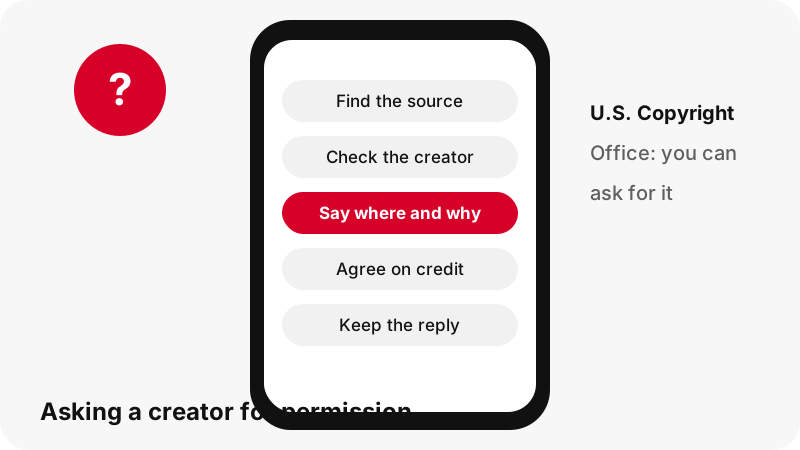
You ask them directly. The U.S. Copyright Office's answer to "How do I get permission to use somebody else's work?" is short: You can ask for it. Pinterest cannot do it for you, since it does not know who holds the rights.
- Open the pin and follow it to its source: the website or profile the pin links to is often the creator's.
- Check whether the uploader is the creator. A pin saved from someone else's site usually is not.
- Write a short message: which clip, where you want to use it, for how long, and whether it is commercial.
- Ask how they want to be credited, and offer a link back.
- Keep their reply. A written yes is your best record if anyone asks later.
If they say no or do not answer, share the pin link instead of the file. It costs you nothing and keeps you clear.
What can you do if someone reposted your Pinterest video?
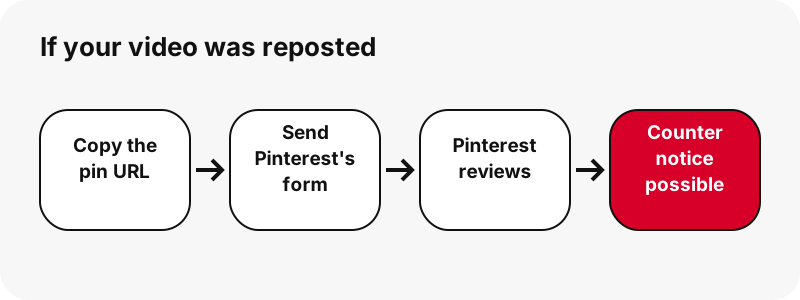
You can file a copyright report with Pinterest. Its Copyright policy, written in line with the U.S. Digital Millennium Copyright Act, says Pinterest will respond to claims sent to its designated agent and may remove or disable the reported content.
“Pinterest respects the intellectual property rights of others and we expect people on Pinterest to do the same.”
- Use Pinterest's copyright reporting form, or send the notice to its copyright agent with the details the policy lists.
- Include the URL of the infringing pin and identify your original work.
- The person who posted it may file a counter notification; Pinterest says reinstatement can take up to 14 business days if no court action follows.
- Accounts with repeated infringement can lose the ability to save pins or be disabled.
- False reports have consequences: Pinterest's help points to liability for damages under section 512(f) of the DMCA.
For anything about our own site, our DMCA page explains how to reach us. We do not host the files themselves.
What does SaverPin do, and what does it refuse to do?
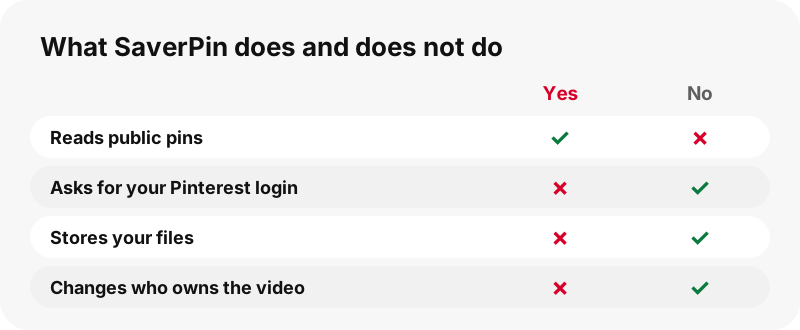
It reads public pins only, the same files Pinterest shows to a visitor who is not signed in. It never asks for your Pinterest password, so it cannot open private pins or secret boards, and it does not store the videos: files stream from Pinterest's servers through a download link that expires after one hour.
We also refuse to over-promise. The largest MP4 Pinterest keeps is 720p, so we never advertise 1080p or 4K, and the audio button gives an .m4a file, not an MP3. The quality page and private pins page explain both limits.
SaverPin is not affiliated with Pinterest, Inc. Using it does not change who owns a video, and it does not give you a license Pinterest or the creator has not given.
A checklist before you use a downloaded Pinterest video
Run through these questions every time a clip leaves your device:
- Is it only for me, offline? That is the low-risk end.
- Am I posting it publicly? Then I need the creator's permission or a clear legal exception.
- Is it commercial, for a client, an ad or a monetized channel? Get written permission.
- Did I change it into something new, such as a review or commentary? In the U.S., that is one of the fair use factors, not a guarantee.
- Do I know who the creator really is, not just who saved the pin?
- Have I credited them and linked the original?
Ready to save a clip for yourself? Start from the Pinterest video downloader, or follow a device guide such as iPhone or Android.
Related guides
- Pinterest videos without a watermark: what that really means
- Pinterest audio: why it is M4A and not MP3
- Saving a public board, pin by pin
- Our terms of use
- Our privacy policy
Frequently asked questions
Is it illegal to download a Pinterest video for personal use?
We cannot give a yes or no for every country. Copyright stays with the creator, and private-copy rules differ by country. Keeping a clip offline for yourself is the low-risk end; reposting is where infringement claims usually start.
Does Pinterest allow downloading?
Pinterest offers a Download image option for some pins. Its Community Guidelines ask people not to use undocumented or unsupported methods to download, and an independent tool like ours is not a documented method.
Can I repost a Pinterest video on TikTok, Instagram or YouTube?
Only with the creator's permission or a clear legal exception. Pinterest's help says permission should be sought from the copyright holder where necessary.
Does giving credit make reposting legal?
No. Credit is good manners, but it is not permission. The copyright owner decides who may copy and share the work.
Who owns the copyright of a pin?
Generally the person who created the image or video, not the person who saved it and not Pinterest. Pinterest says it has no information about who owns a given pin.
What is fair use?
A U.S. legal doctrine that allows some unlicensed uses, judged case by case on four factors: purpose, nature of the work, amount used and effect on the market.
Can I use a Pinterest video in a school project?
Teaching and scholarship are among the U.S. fair use examples, but that is not automatic, and other countries have their own rules. Credit the creator and check your school's guidance.
Can I download private Pinterest videos?
Not with SaverPin. It only reads public pins and never asks for your Pinterest login.
Does SaverPin keep copies of the videos?
No. Files stream from Pinterest's servers through a link that expires after one hour; we do not store them.
Someone reposted my video. What do I do?
File a copyright report with Pinterest using its reporting form or its designated copyright agent, with the URL of the infringing pin.
Is SaverPin part of Pinterest?
No. SaverPin is an independent tool and is not affiliated with Pinterest. It only reads public pins.
Is this page legal advice?
No. It summarises and quotes official sources so you can read them yourself. For a real decision, talk to a lawyer where you live.
Guides
Video — Paste a pin link and save the video as MP4, up to 720p.
Sources
- Copyright — Pinterest Help Center
- Terms of Service — Pinterest
- Community Guidelines — Pinterest
- Copyright policy — Pinterest
- Download an image — Pinterest Help Center
- U.S. Copyright Office Fair Use Index — U.S. Copyright Office
- Frequently Asked Questions: Copyright in General — U.S. Copyright Office
- Can I Use Someone Else's Work? Can Someone Else Use Mine? — U.S. Copyright Office
- What is copyright? — WIPO
- Summary of the Berne Convention — WIPO